An Intro to Daiso's The Game Series (Trump 1, Nekomata Tanteisha, Nyanpoline, TechnoSylph: vsys gaiden)
Today's post is the start of a new series about something a little different: a dive into Daiso's The Game Series, a hyper-budget collection of CD-ROM games.
Daiso is one of Japan's largest chains of ¥100 shops. They sell a little bit of everything: housewares, kitchenwares, small grocery items... and, for a time, video games. For a good chunk of the 2000s, Daiso had its own line of CD-ROM games for Windows that it sold on its shelves the same way it sold its other own-brand goods. Other stores had budget game sections too, of course, but Daiso's line manages to be different compared to the discount section at your Wal-Marts of the world. For one thing, these were Daiso's own-brand games the same way they sold their own-brand goods: they weren't buying cheap discs from other discount publishers, they were actually publishing all of these games themselves. They were also undercutting every other discount game rack in the country by selling their games for the hyper-budget price of ¥100 (about $0.90).
We live in an era where $0.99 is too much to spend on a single mobile game, so it's hard to emphasize just how cheap ¥100 was in this era. ¥100 was a genuinely, unthinkably low cost for a game in that era. By comparison, D3 Publisher's famous Simple 1500 series for the PlayStation was ¥1500 a game in that same era; MSD-Japan's contemporary Gameland series for Windows and Mac was ¥980; and even Sony Music Entertainment's ultrabudget Shock Price series sold for ¥500. ¥100 was the cost of a single credit at the arcade, maybe two credits at the smallest discount arcades running old machines. Accounting for the cost of physically manufacturing and distributing discs, Daiso's ¥100 price point is about as cheap as it's possible to get; they found the floor and stuck to it. How much game can you even expect for ¥100?
Maintaining a steady output of games at this rock-bottom price isn't easy, and that's what ends up making The Game Series so strangely interesting: cheap shovelware is usually boring, but Daiso was working at such a low price point they almost couldn't afford to be plain boring. Daiso leapt at every opportunity they could to find cheap software they could put out, and the result is a genuinely eclectic line of games that mixes bottom-of-the-barrel shovelware, reissues of whatever independent games they could get their hands on, original games from indie developers taking whatever publisher they could find. It's consistently more interesting than the more expensive shovelware series that could afford to be selective or to enforce any kind of consistency.
As an introduction, this post will cover four different games from across The Game Series. Each disc here was chosen to represent a distinct style of game that defines this series. Even more than that, they represent the very different ways that Daiso sought out games to fill their shelves. Going forward, I'll be writing shorter posts covering 1-2 games in between longer blog posts.
Trump 1 (Vol. 7, 2002)
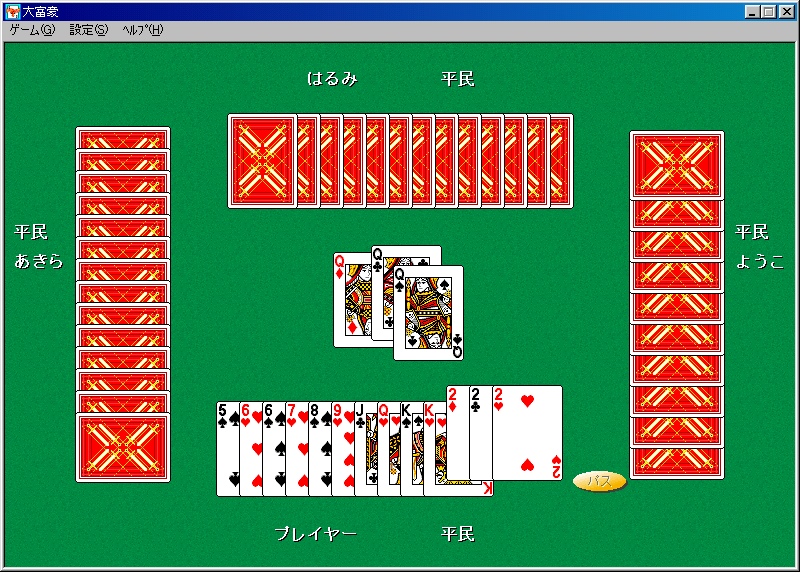
If you picture a hyper-budget game in your mind, it probably looks exactly like Trump 1. I think if you looked up "shovelware" in the dictionary, you would find a screenshot of this game.
In that sense, this is a perfect starting point to explore Daiso's games. Trump 1 isn't exciting, but it really is the true neutral point of discount games. Digital card games are a deep well any budget publisher will draw from: there's no real design to be done, since you're just implementing a game that already exists, and you have a built-in audience since everyone already knows the rules you're implementing. Pick the right game and you're not even competing with the built-in card games on Windows.
Trump 1 is a basic take on three different multiplayer card games popular in Japan: Daifugō, a shedding game; Napoleon, a trick-tracking game from England; and Page One, a Crazy Eights variant. All three of these are four-player games, which Trump 1 presents as a single-player game with three CPU opponents. There is no multiplayer. The presentation is generic, with at best functional card designs. Most players would struggle to distinguish it from the built-in Windows Freecell game or, really, any other digital card game. Unlike Windows Solitaire, there's only a single card back design.
...and that's all there really is to say about Trump 1. It's basic but competent. It simply happens to have no personality or any characteristics to separate it from every other budget card game out there. For ¥100, that's enough.
Trump 1 is the first quadrant of The Game Series game: it's true shovelware that, as far as I can tell, is a Daiso original. That doesn't mean it was developed by Daiso, although the actual developer is uncredited, but it does seem to have been commissioned by them and was not released by another publisher before or after Daiso put it out. We will be seeing a lot of these as we go through the series, though less of them than I may have expected.
Nekomata Tanteisha (Vol. 40, 2003)
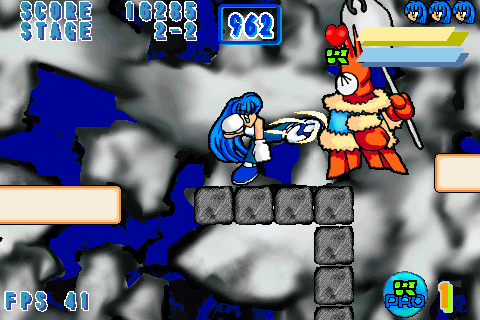
Nekomata Tanteisha is the polar opposite of Trump 1 in every way. Where Trump 1 was a generic, functional version of a game you could find anywhere, Nekomata Tanteisha is bursting with excitement and originality.
This is a combination brawler/platformer with a delightfully handmade look. Players take control of Tail, the main investigator of the Nekomata Detective agency, as she gets sent to look into a case... which seems to involve a lot of platforming and not much detective work. The platforming a bit basic, but the combat system is surprisingly well thought through. Tail has a three-hit punch that she can do with the punch button, but she can also alternate between the two attack buttons to do a variety of alternate combo series, a juggle attack that knocks the opponent up so she can chase them into the air, a Guile-style flash kick, and more. It's surprisingly comprehensive for a little shareware game like this from this period and feels fantastic to play around with. There's plenty of room for experimentation and expressive play.
That it feels so handmade isn't a huge surprise, since Nekomata Tanteisha is an indie production by only two people. Most of the game was made by indie developer Hiroshi Tatefuku, who handled not only game design but also programming and the game's artwork; the music was handled by his friend Aba (aka T. Kobayashi). Tatefuku released a handful of other shareware games and eventually ended up getting a job at Sega's arcade division.
Nekomata Tanteisha is also the polar opposite of Trump 1 in production: it's a licensed reissue of a game that had come out several years earlier. It was originally released as a shareware game in 1998; players could download a one-stage demo for free, and pay a ¥1000 yen fee online to get a code that unlocks the rest of the game. Of course, in 1998 many people had neither internet access nor a way to do online payments, so there was only so far a self-distributed shareware game would get you. The next year, it would end up being rereleased on CD-ROM by MSD-Japan in their Gameland series at the ever-so-slight discount of ¥980. Sales must have been tapering off by 2003 when Daiso got around to it, since ¥100 is a big discount from either of those earlier prices.
(The Gameland name will show up again in later posts: by 2003, there's some evidence to show that MSD-Japan were partially or exclusively supplying Daiso with games. A decent chunk of The Game Series is made up of discs MSD-Japan had released at ten times the price a few years earlier.)
Nyanpoline (vol. 26, 2004)
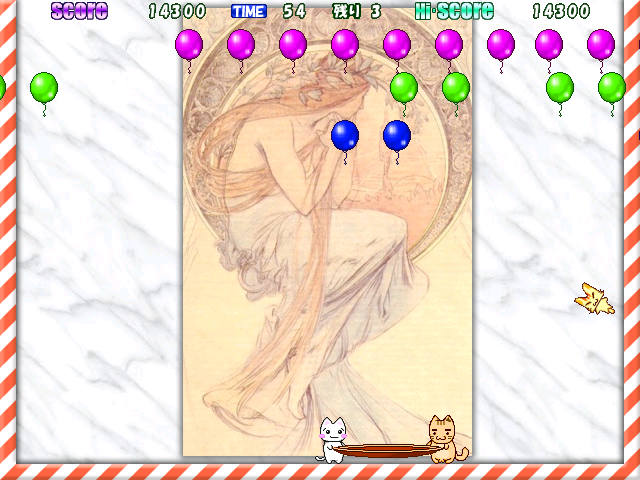
Nyanpoline is another Daiso original, like Trump 1, but it couldn't be any more different. It's a take on a standard budget game genre, yes (a version of Breakout), but it's absolutely filled with personality. A team of cats with a trampoline have set out to pop every balloon in a stage; players use the mouse to control the two cats holding the trampoline while they catapault a third cat into the sky. It's fairly typical Breakout, but the theming and physics are both very on point. Keeping control of the cat as they bounce off the balloons around around the stage becomes a real challenge, and it really does feel like the player is chasing something around with a trampoline more than the typical "ball bouncing from a paddle" of this kind of game. The sprite design for the cats is especially great, with the cat who's flying through the air showing a delighted little expression as they careen through the stage, and the cats holding the trampoline looking appropriately stressed out any time they miss and the cat ends up hitting the ground. With the public domain background art and music it's very obvious this game was made on a tight budget, but equally obvious it was made by someone who cared a lot about what they were doing and who was putting all of their limited resources in the right places.
This may be a Daiso original, but it's far away from the bottom-tier shovelware that marks most of the originals in Daiso's line. I consider this one a separate category from games like Trump 1; not true shovelware, but Daiso hidden gems that are worth seeking out to play even on their own merits.
Unlike most Daiso originals we know exactly who made Nyanpoline: independent developer Nanshiki Corporation, who are still around to this day. They must have liked the game because they ended up republishing it for iPhone and Android in 2011. Both versions have sadly been delisted, but at least the old PC version still works on modern Windows.
TechnoSylph: vsys gaiden (Vol. 68, 2003)
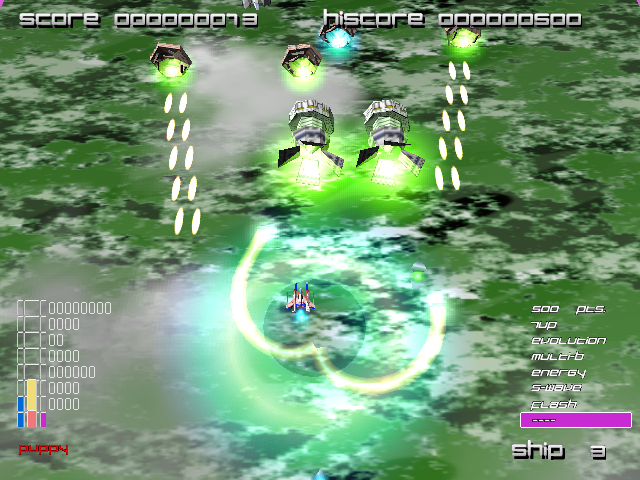
Here's another surprise: I would not have expected a hardcore 2D shooter to be in the collection, and yet here it is. TechnoSylph is a score attack-based 2D shooter with 3D artwork. The player controls a ship taking on endless waves of enemies coming from the top of the screen, trying to get the highest score they can before they inevitably die. Like a lot of doujin (independently-devleoped) shooting games of this era, it has quite baroque mechanics that take the player awhile to get their head around; the player has seven different shot types, which the player can shift between using something akin to the gear stick on a manual drive car, with the player needing to micromanage exactly the right shot to use at exactly the right moment. The more powerful the shot the player chooses, the slower the player's get-out-of-jail-free bomb recharges, so the player has to constantly be judging exactly how much firepower they need while making sure they're not depriving themselves of the opportunity to use their bomb when they need it. It's a game for true genre fans, which makes me wonder what the average ¥100 game buyer thought of it.
As you might imagine, a game this polished didn't start out as a Daiso game. TechnoSylph was originally a freeware game which Daiso picked up to put in their series. The rest of the games so far have been obvously better deals, but Daiso actually put out several games that anyone could go online and get for free if they wanted. (These were, of course, published with the developer's permission.) In the early 2000s, many people still didn't have internet access at home, so it may have been worth ¥100 to someone to get a copy of a game that would have been inconvenient for them to download for themselves. Alternately, of course, Daiso may just have been relying on the audience for ¥100 games to be undiscerning and to have no idea they could get the game for free. (Daiso even put a different name on the packaging, as they did with some of their other games for marketing purposes; the front of the CD case calls it simply Tategata Shooting, e.g. Vertical Shooting, although there's a screenshot of the actual in-game title screen with the real title on the back of the case.)
Unlike many of the other freeware games in The Game Series, TechnoSylph is something a little more special than just a freeware game on a CD. The developer seems to have been proud to have been chosen for inclusion in the collection, and so they made a special remix of their game just for Daiso. The version you get on CD features new level designs with different enemy placement and an overall higher level of difficulty than the original freeware game. And if the player thinks that's too much? Well, they can always go get the easier version of the game for free.
Coming up next time: a billiards game, and ¥100 store Myst.