A Trip to 90s Kansai: Exploring the XD FirstClass Network BBS
This post is going to do something a little different. I recently came into a very unusual CD and I'd like to explore its contents with you.
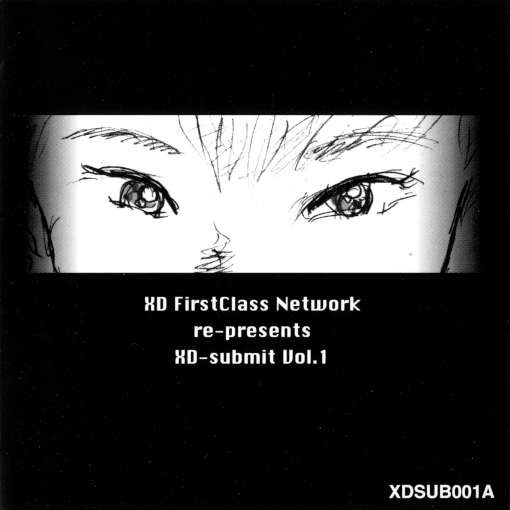
If you've been reading this blog, you can probably tell that I buy a lot of CD-ROMs. I usually do my research ahead of time but if something is cheap enough, or has a cool-enough looking cover, I'll take a chance on it just in case. This was one of those discs, which I stumbled into while browsing the Mac CDs at Suruga-ya; I could find almost nothing about it online, but something struck me about the sketchy cover art and the "XD FirstClass Network" title.
XD-submit Vol. 1, as it turns out, is a promotional disc for a Kansai-area bulletin board system (BBS) called XD FirstClass Network. As I started digging into it I assumed this would be sort of a basic information kit, a digital pamphlet or something, but it's something a lot more exotic: a functioning archive of the BBS with its original client software for Mac. This was supposed to be a demo so you could browse it offline and decide if you wanted to join, but here in 2026, when this BBS has been offline for three decades, it gives us a chance to actually see what it was like when it was alive.
I've read plenty of archived web forums before, but I've never seen a BBS archive quite like this before. 1994 is before the Internet Archive started collecting webpages, but these aren't webpages anyway: BBSs are a pre-internet technology, and BBSs really weren't being archived in the way that webpages are. The idea of being able to browse a period BBS like this using its original interface, just like an archived webpage, is incredibly cool to me and I didn't think I'd ever get the chance to see it.
In 1994, XD seems to still have been a pretty young BBS. It had a small but highly engaged, tight knit community that we'll get to know by reading these posts. These kinds of communities tended to skew pretty small back in the day, but they clearly wanted to grow: they've presented themselves here on this CD for us and chose these posts specifically to show to us so that we might consider joining. They'd like us to be their friends. 30 years on we can't, of course, actually join their community but at least we have the chance to get to know them as they would have liked us to.
Before I tell you that story, though, I have to tell you this one. You see, if you ask the internet about the XD-submit CDs, they'll tell you they're albums. They are that too—put them in your CD player and you get a set of tracks from Kansai area electronic/techno artists, all of whom seem to have been connected to this BBS when it was alive. It's good music, and I absolutely see why people interested in the Japanese underground techno scene have latched onto that angle, but I think it's a bit of a shame it's the only part people want to discuss. After all, this isn't just promoting the musicians but promoting the community that they were a part of. So let's bring the two together: I've embedded a playlist with as much music as I could find on YouTube from across the four volumes of XD-submit. Consider hitting play and enjoying the music while you read their posts.
Imagine yourself, in 1994, wanting to talk to someone else over your computer. You probably won't have the internet (most computer owners didn't, even if they had a modem). Even if you did, the web, which had only been open to the public for three years, had very little on it, and web forums didn't exist yet either. You did have a few things to use your modem for, though, and one of those is BBSs like the one we're looking at today.
When we look at a BBS like the one we're looking at today, just keep in mind this is a pre-internet technology[1]. When you use a BBS, you're dialling directly into one server, not a worldwide network. And since you're dialling, using your modem's telephone line, you're probably connected to a BBS somewhere close to you. Long distance calls cost money, after all. You're doing something online, but it's less global than you're used to on the internet. It means that a lot of BBSs were populated by people in a specific area, sharing locally-relevant information, and you'll be seeing a lot of that here.
BBSs gave way to the internet once internet- and web-based systems showed up in the 90s, which makes this specific snapshot an interesting time to look at. The very first web-based forums launched in 1994, but they wouldn't widely used for awhile. The web itself had only been available to the public for three years, and most computer owners still didn't have access in 1994. This archive, from 1994, is at exactly the point when BBSs were still being widely used[2] and right before users would start moving over to new services. XD is a young enough BBS that we're not really seeing what the BBS scene as a whole looked like at its peak, but it is a pretty interesting look at a newly-launched BBS in what was, at the time a pretty mature scene.
So what was XD in its infancy? Well, it wasn't a one-topic forum, but if you were to define it by one topic it'd be music. A number of its prominent members were active in the local techno scene, like the members of Osaka post-new wave band Controlled Voltage. (Member Sunao Inami seems to be internationally recognized enough to have his own English Wikipedia article.) Even the admin, Yoshiken (Kenichi Yoshida), performs on tracks from later XD compilations.
This archive covers sections of 1994, with the most recent archived posts dating to mid-September[3]. It's been assembled as something of a core sample; roughly the same number of posts was collected from each subforum, which works out to be about three weeks' worth of posting history for the most popular forums and as much as nine months for the quietest ones. It's not a comprehensive archive, but it's a great little cross-section showing us what the BBS was like in its heyday and what kinds of conversations users were having.
Before we start diving into posts, let's take a tour of actually using the BBS itself. XD used the Canadian FirstClass BBS system and the demo that came on our CD is for Mac[4], so we'll be exploring on a 1994-vintage Mac OS system.
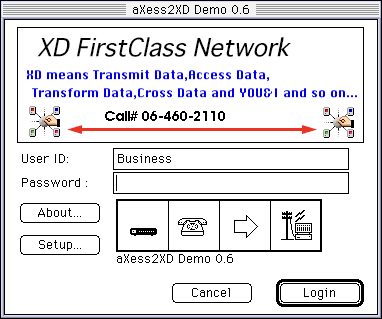
The first thing for us to do, of course, is dial in. If we were doing this for real it could be a slow process; we would need to wait to actually dial into the BBS's modem (remember, we're dialling them directly! this isn't the internet!) and wait to negotiate a connection, and we might even get a busy signal if there are too many people already connected. Luckily, since we're just simulating it, we don't have to sit through that long process. Once we fill in our authentication information[5] and hit the login button, it simulates a very fast dial-in and lets us get to the BBS itself.
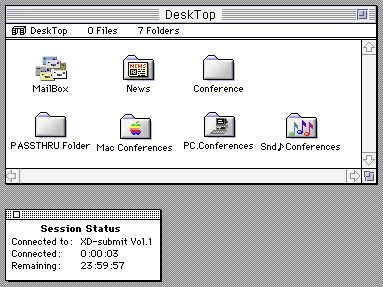
One we log in, the first thing we get to see is the FirstClass desktop. FirstClass plays heavily into the desktop metaphor, so this looks a lot less like a web forum than we might expect nowadays. Instead, FirstClass navigation feels a lot more like using the Mac's Finder file browser, complete with folders to organize your content and persistent history of where you place the folders and the windows that open when you click those folders. Not what I expected, but pretty interesting stuff! (That little window at the bottom, by the way, tells us our connection time since our time on the BBS is metered. A BBS can only keep so many connections open at a time, so the software is set up with a time limit to prevent users from staying on too long. A timeout feature will automatically disconnect if the user hasn't done anything in awhile. Since this is a demo, we've been given functionally unlimited time... but we do still get logged out if we leave it idle for five minutes.)
Most of these folders contain what FirstClass calls "conferences", or what we'd call "subforums". (FirstClass seems to have been aimed at business users, so a lot of the terminology is very business-ey.) We also have a "News" icon, which is a special conference for the admins to post announcements, and a "MailBox" for private messages that works a lot like email. (It's not actually email though, and has to be read here on the BBS.) It also contains the special "PASSTHRU" folder that I'll talk about later.
I won't comprehensively show posts from every conference; I'll browse through the conferences highlighting whatever seems interesting. Since music was such a big part of XD's identity, I'll be highlighting the music conferences in particular. There are eight main music conferences:
- Rock me on, which discusses rock music
- MIDIum, for discussing MIDI software and hardware and sharing music
- Techno Hardware, a "hardcore" techno forum for music creators to discuss hardware and technique
- Techno Software, a "softcore" techno forum for discussing crossover techno elements in other music genres
- TEKNOの穴 (eg Tekno Hole), a chaotic-feeling techno discussion forum
- HR/HM (Mekong!), a forum for hard rock and heavy metal. Its namesake is the German band Mekong Delta.
- Rock in progress, focused on progressive rock
- Marching Forum, focused on Japanese marching bands
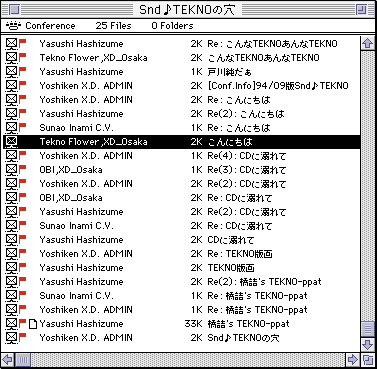
When we open the conference, it pops open a window that looks a lot like an email inbox. This is what browsing a forum looks like in FirstClass; remember, this is before the concept of the web forum really existed, and our model for what a forum system looks like wasn't really there yet! We'll see what looks more like email when we start reading messages in a moment.
This is the general techno forum, not specifically the music producers' forum, so there's plenty of chatter about listening to music from non-musicians—not all of it new music, not all of it local. Here, for example, is frequent poster Yasushi Hashizume opening a thread with the highly relatable subject line "Addicted to CDs":
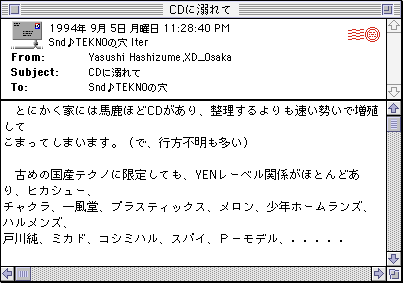
Our poor poster keeps accumulating CDs faster than they can reasonably organize them! Who among us? In complaining/humblebragging about their growing collection of Japanese techno and Yen Records albums (Jun Togawa mentioned!), they predictably kicked off a long thread of other users commiserating and also taking the bait by admiring their list of albums and branching off subthreads to chat about them.
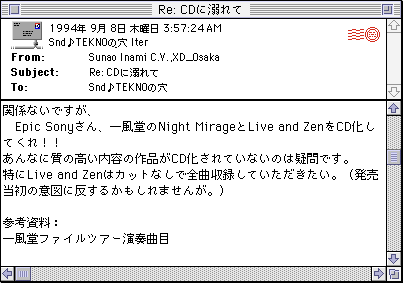
Here's Controlled Voltage's Sunao Inami zeroing on in the reference to Jun Togawa's Shijin no Ie as an excuse to hijack the thread in order to beg Sony (who's assuredly not reading!) to reissue Ippo-Do's albums Night Mirage and Live And Zen on CD[6].
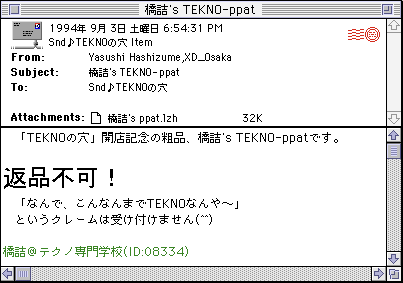
Elsewhere in the Tekno Hole, I came across another post from Hashizume with something else I didn't expect to find. It turns out that this XD backup contains attachments, not just the post text! Hashizume created a set of techno-themed Mac background patterns (this being in the era when operating systems could do tiled backgrounds but not full background images) and attached it in a post, and it's been preserved here on this CD for us. Let's admire:
 |
 |
 |
 |
 |
 |
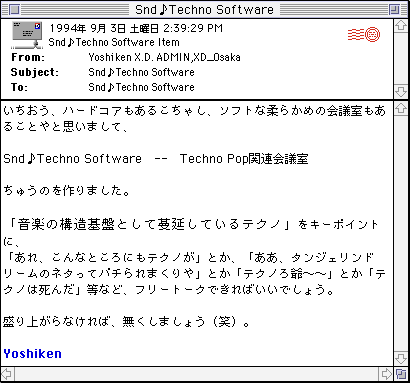
The Techno Software conference name might imply it's about music-making software, but it's not really about "software" at all. Instead, it's about "softcore" techno; that is, techno-pop or techno-influenced pop music. A post from Yoshiken, the admin, lays out an interesting manifesto for the forum outlining an ethos of discussing techno as the common structural element of contemporary music (「音楽の構造基盤として蔓延しているテクノ」). Which, by 1994, is pretty on-point!
That said... the population of XD may be a little too hardcore into techno to stay on this particular topic. Threads I've seen include discussion of British group Coco Steel & Lovebomb on Warp Records and discussion of a then-recent Hard Trance 303 Japanese techno compilation. Hardly techno pop! Perhaps the most on-topic thread is this interesting discussion of Kraftwerk-related albums, especially the Balanescu Quartet's Possessed (1992), a contemporary classical album broadly made up of Kraftwerk covers. The poster marvels at the recreation of techno sounds entirely via acoustic instruments and, having listened for myself, I can't disagree. It's a fascinating album!
On the topic of "techno software" as I originally expected it to be, the one thing we unfortunately don't get much of on this forum of music makers is actual music. This is the dialup era, specifically the slow dialup era, so sharing full recorded songs is out of the question. (MP3 wouldn't launch until next year, anyway.) In this era we might have expected to see people sharing MIDI files intended to be played back on specific DTM MIDI devices, or maybe tracker modules, but unfortunately there aren't any threads where people are sharing either in this archive. MIDIum, which seems to have been brand new at the time this archive was created, has a thread where a user inquires about uploading MIDIs but it doesn't seem anyone actually did so in the period this archive covers.
...or so I wrote before I started skimming the MacLIB filesharing conference. In and among the Mac shareware and freeware utilities, I discovered a track uploaded by XD's own Yasushi Hashizume! (That name has popped up in several screenshots in this post; he was a frequent poster.) This is a cover of Yello's Oh Yeah (as made famous by Ferris Bueller), and it really does manage to squeeze a pretty faithful rendition of the original song into just 120KB despite having to give up a few of the famous vocal samples. It doesn't look like this is Hashizume's own work, unfortunately; I'd been hoping for the chance to listen to an XD poster's desktop music. At the very least, it's an interesting little look into the kind of music that XD's posters were seeking out on their computers. If you want to hear for yourself, there's a copy you can listen to in your browser right here.
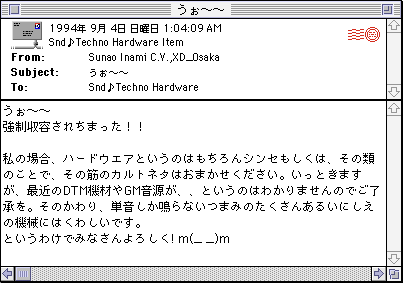
Meanwhile, over in the Techno Hardware conference, we have a more "hardcore" set of discussions. Like Techno Software, the guidelines for what exactly constitutes a "hardcore" techno discussion are pretty vague, but most of the chatter here is about techno music-making hardware and techniques. Like the last conference I went in expecting exclusively hardware-related topics, but the actual set of topics is quite a bit looser. There is quite a lot of hardware chatter though. Here, for example, is DJ and Controlled Voltage bandmember Sunao Inami introducing himself self-effacingly as someone who doesn't know the first thing about modern DTM MIDI hardware but an expert on old hardware with all the knobs that produce a single note at a time.
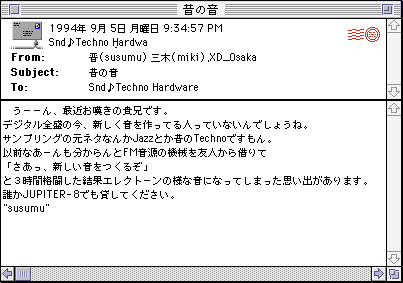
Actually, it seems XD had quite a few longtime synthheads who were all too happy to continue discussing their faves. Here we have Susumu Miki lamenting that no one seems interested in creating "new sounds", by which he means creating waveforms yourself instead of using samples. Which sounds dramatic, but isn't an entirely wrong reaction to the heavily sample-based sound of mid-90s techno. It must have been a dramatic shift for people who still liked analogue synths the best. The very next thread, in fact, discusses a set of sample files to recreate older Roland synths using modern sample-based digital software. (This seems to have been a popular kind of tool in the early desktop computer days; despite Sunao's claim he only knows how to use analogue synths, the CD includes his own recreation of Roland's TB-303 as a set of digital files people could use to create music at home on their Macs.)
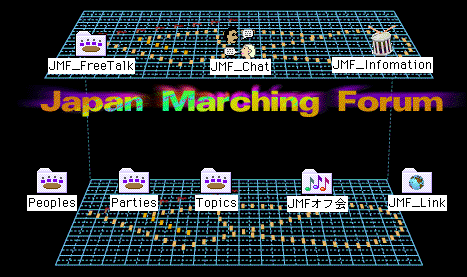
Moving away from techno, the Marching Forum folder has a set of conferences that surprised me mostly in that they existed in the first place. I had no idea that marching bands were popular enough in Japan to sustain this much conversation, but this was a busy set of conferences filled with discussion about upcoming events and marching technique.
The other big surprise to me is that this is one of the very few parts of XD I can find any record of online... and, in fact, Japan Marching Forum seems to have survived the end of XD itself. By late 1997 it had its own webpage and a simple web forum that seems to have kept going well into 2005. Beyond that, though... Japan Marching Forum seems to have migrated its FirstClass BBS to the internet! You still used the FirstClass software to access it, but you didn't have to dial in anymore and could access it from, theoretically, anywhere in the world. (I have to imagine it didn't see much activity outside Japan, but maybe this helped it go national.) I knew that FirstClass morphed into providing internet-based services, but this is the first example I've seen of a personal, non-corporate BBS from this era still using it instead of fully migrating all their services to a web browser. I'd love to know how long the FirstClass internet era lasted for forums like this before they moved fully onto the web.
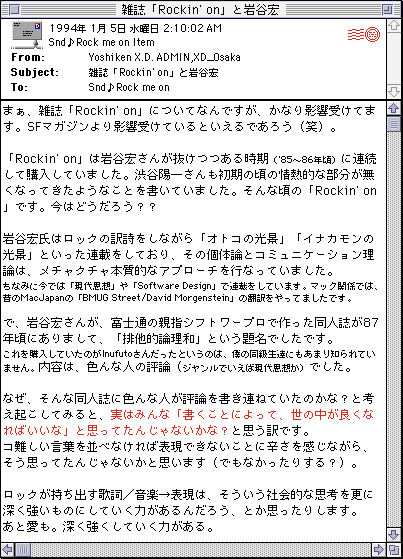
I've mostly skipped the tech talk on XD because, quite honestly, enough ink has already been spilled about early computer-users using computers to talk about computers. There is, however, one thread in Rock me on that struck me.
The administrator, Yoshiken, opens up a discussion on rock journalist Hiroshi Iwatani, who cofounded the influential Japanese rock music magazine Rockin'on in 1972. The part that caught my eye wasn't the music, though, but the comment about Iwatani's career pivot: in the mid-80s he resigned from Rockin'on, quit music journalism, and got into computers. (Spent the rest of his career in computers, at that; he was at TechCrunch Japan from 2008 until he retired in 2022.) When I see a left-turn career transition like this I always find myself wondering what happened, but Yoshiken offers an explanation in a followup post: that Iwatani had been drawn to rock music because of its radical potential for interpersonal communication, but that by the mid-80s he had become disillusioned with how commercial rock music had become and began developing an interest in the potential of computers instead.
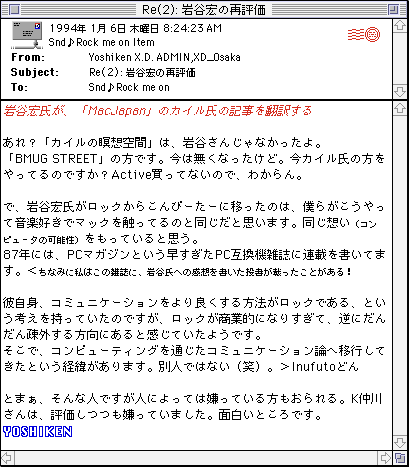
It's increasingly hard to remember, but there was a time when home computing felt genuinely revolutionary. Not just a commercial revolution for the companies driving it, that is, but a personally, individually empowering force. The mid-80s would have been exactly the right time for someone disillusioned with the power of one revolutionary medium to put his hope in computers next, just as the 90s seems to have been the right time for XD's music freaks to come to the same conclusion about their passions. They were nowhere near as radical as Iwatani seems to have been (in the 90s he was publishing books with titles like "Radical Computing: The Ultimate Machine for the Mind"), but they saw the start of the computer revolution and immediately latched onto what it could do for their passion for music. And for music this really was the start of the computer music revolution, the time when it felt the future could bring absolutely anything. It might be quaint thinking about how exciting it might be to make music on a computer, just as it is to read about Iwatani making a zine on a computer in 1987, but it was exciting to this group of people all the same.
It's that excitement that brought this group of people together on the computer in the first place. It's easy to cast early online communities as computer nerds talking to each other about computers on computers, but this conversation really highlights why these communities were more diverse in their interests than the stereotypes suggest and what they had to offer the people who came to them from a less-computery background.
I'm also struck, reading this, with how much my own relationship to computers feels like Iwatani's relationship to rock music in the 80s. I, too, was attracted to something I thought had revolutionary personal potential and I, too, have seen that potential slowly sapped away as the medium becomes more and more tightly controlled by a smaller and smaller pool of corporate interests. I don't really have a conclusion here, and I'm not about to drop this blog to pursue a new career in rock journalism, but there's some kind of comfort in seeing someone walk a path this similar to mine and struggle with the same thoughts I have. It's also helpful seeing these conversations in this particular time and place. I'm not seeking a nostalgic return to that time (as much as my very "1996" site design might make you think that), but rather that there's something grounding about seeing this passion and energy.
I gestured briefly at the PASSTHRU folder earlier, but I really want to dig deeper into that because this is something very cool. I said before that when you're connecting to a BBS like this, you're connecting to one system rather than the internet as a whole. This is a bit of an exception to that. FirstClass had support for what they called "relays", which allowed BBSs running the same software to talk to each other and exchange messages. It wasn't a realtime connection; this still isn't the internet. It's a little bit more like snail mail. The servers would sync with each other every day, or once every few days, fetching new replies in the conferences they were sharing and transmitting any replies that had been made from a different server. It's quite a bit more "slow internet" than we'd probably tolerate today, but in the pre-internet era the idea you could be talking to these other communities at all would have felt revolutionary.
On this demo CD, we've got connections to a few different networks: AppleCenter Higobashi, Virtual Nipponbashi (Virtual日本橋), and SimNaniwa (Simなにわ), all of which seem to have been located in the Kansai region too[7]. AppleCenter Higobashi and Virtual Nipponbashi seem like they've left basically zero trace on the modern internet; there are zero search results on the web for either name, which makes it all the more remarkable we don't just have information about them but an interactive copy of some of their messages!
More than just the archive though, we've got an incredibly cool presentation. I talked a little before about how these BBSs are very regional and local to specific areas. These BBS operators decided to make that explicit: each is presented as a pixel art map of a region of Kansai, with little conferences dotted around in areas they're local to. At a time when the internet was about to go global, it's fascinating seeing something that's leaning this hard into being specifically local instead. I'm not going to do a conference by conference summary of these BBSs because, frankly, the amount of content in here could easily be a whole series of posts on its own, but how about we take a look at the maps and see how they chose to represent themselves?
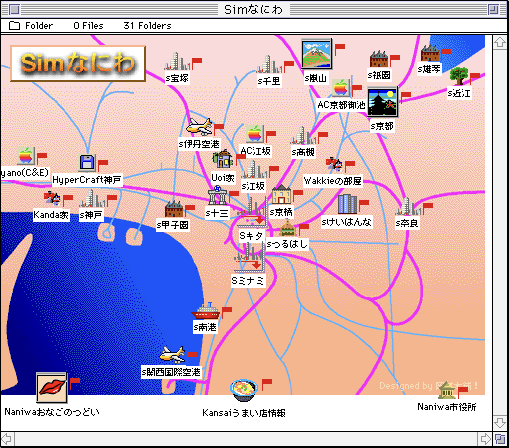
Let's start with the main SimNaniwa map. SimNaniwa was located in Osaka and seems like it also served surrounding areas; it depicts itself with a nice little pixel art map centred on Osaka and its environs littered with icons representing different conferences. A lot of what we can see on this map is regional—take a look to the west and we can see a few local conferences for Kobe (神戸). Over to the east we can see conferences for the cities of Nara (奈良), Kyoto (京都), and more. But we're not just looking at cities; there are conferences for local landmarks too, like Osaka's Kyobashi Station (京橋), whose threads are lit up with people talking about their train commutes or the best places to watch fireworks near the station. I'd already been expecting local content after seeing the flavour of the discussion on XD, but this is far more specifically hyperlocal and it's genuinely quite charming.
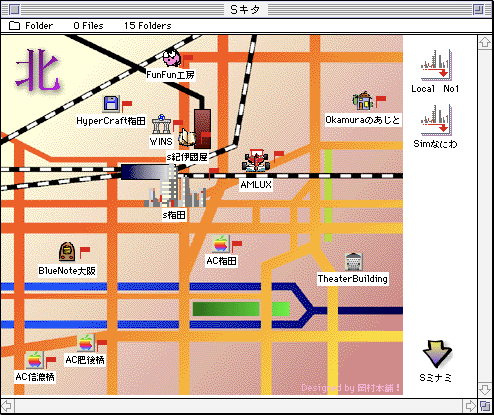
This is only the first of a few SimNaniwa maps, though! Click on "SNorth" (Sキタ) and we get directed to a whole second map. This one is a little zoom in on northern Osaka centred around the Umeda (梅田) region. Umeda's a major shopping district and the conference right at those big buildings seems like it was very focused on that specific shopping area; the very first post is a poster telling people about a new food court that just opened up and promising to report back. (Regrettably, they say they spent too much on their Mac to afford lunch out today.) This map seems in general like it's a little more focused on businesses and similar kinds of spaces, since it also includes a conference for specific named places like the Osaka BlueNote jazz club or the digital agency Funfun Kobo (FunFun工房)[8]. These conferences weren't operated by the businesses they're named after, and this early in the history of online communities it's extremely unlikely most of them were even aware people were there talking about them. A big exception is Funfun Kobo; the lively discussions here include the business's actual owners.
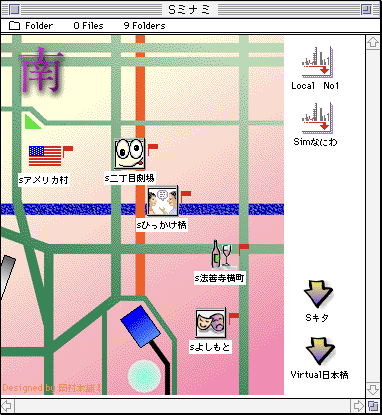
The bottom of that map has an arrow pointing down with the label "SSouth" (Sミナミ); double click on that and we get a new map, this time a closeup of the southern region of Osaka. This area, bounded by Namba Station to the south and Amerikamura to the west, is back to more general neighbourhood discussions. "Amerikamura", for example, is devoted to discussing the popular Amerikamura entertainment district near Shinsaibashi, with threads devoted to discussions of local businesses, theatres, and more. That theatre with the silly face just above Dotonbori appears to be the Shinsaibashi 2-Chome Theatre that was there at the time; this wouldn't be Osaka without a place to discuss comedy after all.
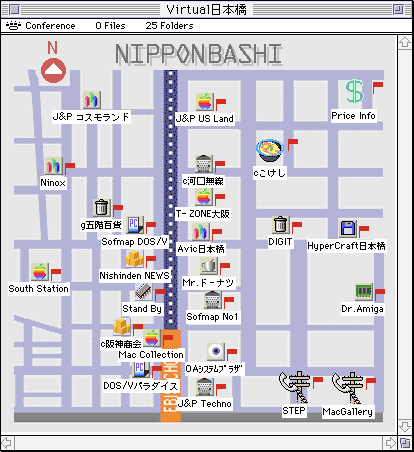
Click the furthest south arrow here, and we land somewhere else entirely. This map of Nipponbashi actually belongs to a separate BBS, Virtual Nipponbashi (Virtual日本橋), but it seems that the two BBSs used relays to link their maps to each other and present them almost like one big area. In the real world Nipponbashi is a major historical shopping district in Osaka that, in the 90s, was very much like Osaka's version of Tokyo's Akihabara. It makes sense that early Osaka computer nerds would choose to recreate it digitally as a place to hang out online.
Virtual Nipponbashi seems to have been a slightly less geographically bound space than SimNaniwa. The map we've got here recreates Nipponbashi, but these conferences aren't specifically about the physical places on the map they represent the way they did in SimNaniwa. Instead, we've got what are basically a set of virtual "shops" or communities that are there for people to talk about the kinds of things you'd go to Nipponbashi to shop for. As usual for a FirstClass BBS, we've got plenty of Mac-focused conferences such as the "Mac Collection" conference where people talk about their own personal computers, but the other platforms get to be represented too: a "DOS/V[9] Paradise" conference has plenty of space for Virtual Nipponbashi's smaller group of PC devotees to post about their interests, and there's even a "Dr. Amiga" conference on the outskirts for the small Japanese Amiga contingent. (Of course, this is 1994, so the spectre of doom is omnipresent: one of the very first threads in the Amiga forum here is about Commodore's bankruptcy.)
Even though most of Virtual Nipponbashi seems to have been topic-focused, we can find at least a little bit of hyperlocal content here. The "HyperCraft Nipponbashi" conference is about the real-world HyperCraft shop that existed just off Nipponbashi in 1994. This was a Japanese chain of Mac-specific software shops; this profile from January 1995 about its Akihabara location highlights it as a place to get Mac software, and the name certainly does keep coming up in Mac circles in this time period. The threads here are full of people discussing the Osaka shop itself as well as its other regional branches like the Kobe shop that, reportedly, had just opened in April of that year. This article likewise covers Sofmap, a titan of computer hardware in this era, which also had a real-world Nipponbashi location and which gets its own conference here.
These four large areas are all the maps we have in the PASSTHRU folder. Unfortunately, since I don't have any later archives, it's not clear how these communities might have grown after this. I'd love to see archives from 1995 or later, if they exist, to see how they might have chosen to continue growing or whether they ever added any new areas.
So what happened to XD? I don't have the official word, but I've done some digging and I'm able to make an educated guess. Like most BBSs, it would probably have gone into rapid decline starting in the late 90s. The official list of XD-Submit CDs ends in 1997, and it seems likely the BBS itself shut down sometime around then. Based on that chart I shared earlier, this fits the common pattern: BBSs thrived for the first few years of the web, but as the web suddenly skyrocketed in popularity people started leaving BBSs and they began closing into the late 90s. For a small BBS that had just been born in 1994, it's not a surprise that XD would have shut around then.
That's not quite the end of our story though; I happened to stumble across two bits of information that give us an epilogue. First, as I mentioned before, the Marching Forum conference split off into its own BBS and web forum that survived the end of XD by almost a decade. In its independent form, it claims it was hosted by something called "Cave"... which takes us to my second discovery. I linked to XD's official list of CDs above, and we have that because XD was on the internet at some point. Their website was never archived while it still belonged to XD, so we don't know exactly what was on there, but we do know what it was in 1999: a new internet-based FirstClass BBS called "Cave". The same Cave that was hosting Japan Marching Forum! That's not the only "Cave" in question though. This is also the same "Cave" as the one from Cave Studio, the recording studio belonging to regular XD poster Sunao Inami. In other words, as far as I can tell, "XD" itself may have shut down by the late 90s but it was replaced by another community run by one of XD's most prolific posters and hosting some of the very same communities. I don't know exactly how late Cave operated but Wayback machine archives show posts at least as late as 2001 and it was still online as of 2008, which is pretty late for this kind of BBS. And to this day, even though it's been offline for nearly 20 years, Cave Studio still links to the Cave BBS.
As we leave XD for now, I'm left thinking about what an incredible thing it is that we have this archive at all, much less in the way we do. I've read a lot of archived forums over the years, but this archive feels very different from the usual web forum archive. They're rarely made by the forum's own operators or its users; a web forum archive is usually done by outside parties, or even just by chance. The members of web forums aren't necessarily aware their community is being archived, or may not want their posts preserved outside their original context. This archive has a purpose, and was created by the BBS's operators and on behalf of its users specifically to show to other people. We were meant to see this archive, we were meant to be reading these posts. They wanted us to have this chance to be introduced to them from a distance. Even though we can't join them, these many years later, we can at least get to know them and learn who they were just as they wanted us to. I'm grateful we have the chance.
What I've written about here is only a fraction of what there is to find on this CD. If you'd like to visit XD yourself, I've uploaded a copy of the CD online so that you can try it out in a Mac emulator. If you don't already have one set up, you can click here to open an in-browser Mac emulator with the CD already loaded. To launch the BBS software, run these steps:
- Hold down the option/alt key and double click the disk icon with the text that reads "Option+ダッブルクリックしてね"
- Double click the icon that reads "aXess2XD Demo 0.6"
1. As I'm sure someone will point out, there are BBSs that operate over the internet now, but the classical BBS was a non-internet service that people connected to directly. ↩
2. Stats suggest that 1994 is the exact peak of BBS usage, with the number of active BBSs dropping off sharply after that. ↩
3. The dates suggest the actual archive was created in October, but the most recent exported posts are from late September. ↩
4. FirstClass was originally a Mac-only BBS system. By 1994 it had a Windows client too, but XD seems to have seen itself as a Mac-forward BBS and its CD only includes the Mac client. So we'll be using that! ↩
5. The "Business" username in that screenshot comes from the original FirstClass demo this disc is built on top of. That demo app has a default user named "Robert Business" and a series of very business-ey demo forums. XD changed the content but not the default user identity. I do like the idea of Robert Business enjoying himself talking about techno. ↩
6. He had a long wait. Night Mirage finally made it out on CD in 2013, while the best of my ability to tell, Live and Zen is still waiting. ↩
7. These names are all very regionally-specific: "Naniwa" is an old name for Osaka, Nipponbashi is a shopping district in Osaka, and Higobashi is a train station in Osaka. ↩
8. Not especially relevant to the article, but it seems like Funfun Kobo were still in that spot right up until at least 2010 when they seem to have closed up shop. ↩
9. "DOS/V" is the name for IBM's Japanese-localized version of DOS, but it's also a catchall term for IBM-compatible computers in Japan. When people talk about "DOS/V" in this context they usually mean it the same way we would talk about "PCs" in English. ↩