Father Christmas
One of the strangest artifacts of video games as a global medium is that games aren't always developed in the places they're meant to be released. It must be a strange experience developing a game knowing that people in your own country are unlikely to ever see it. The subject of this post is one of those games: developed by a British team located in the UK, based on a series of books by a British author, but published exclusively in Japan.
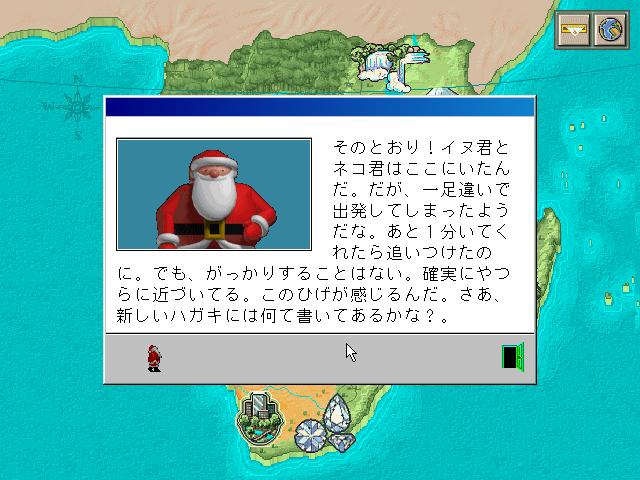
Father Christmas is very loosely based on the 1991 cartoon of the same name and two popular British storybooks by author Raymond Briggs. Along with his storybook The Snowman, these are genuine Christmas classics in some parts of the world. The cartoon follows a version of Father Christmas living a down-to-earth British life. Exhausted after the Christmas season, he sets out on a vacation around the world and has misadventures in a variety of different countries before finally returning home and doing his annual Christmas present deliveries.
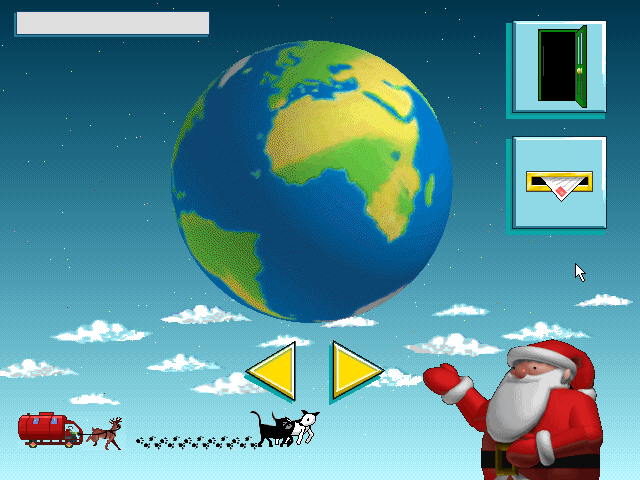
The game follows the cartoon's plot in only the vaguest sense. A lot of children's CD-ROMs adapted from books and cartoons adopt a storybook format that tries to retell the original plot, but not here. In fact, there's almost no story at all. This is, instead, a geography quiz game that tasks players with guesing at the locations of world landmarks. The main game mode roughly adapts the "trip around the world" concept, but the framing device here is that it's Father Christmas's pet dog and cat that have gone on vacation rather than him. Every round they send a postcard from their latest destination describing it in vague terms; players have to navigate around the in-game globe to locate one of the in-game landmarks that matches the hint. If the player gets it wrong, Father Christmas gives the player a more direct hint and lets them try again. This continues as long as the player wants; there's no further story and no more variety in the game format beyond new places to track the cat and dog.
Maybe the strangest omission here is a way for the player to explore the world and learn about places while trying to track down the pets. The game does have a regular atlas mode, in which players can use the same interface to explore all of the different landmarks in the game and read a bit of text about them, but this text isn't available when playing the game mode. If players want to learn more about the game to improve their chances of tracking them, they have to quit the game mode and switch over to a different mode... and if they then want to get back to finding the pets, they have to quit the atlas mode and start the game mode over from scratch. It's a strange design and almost feels designed to make the game feel like it has slightly more variety than it really does.
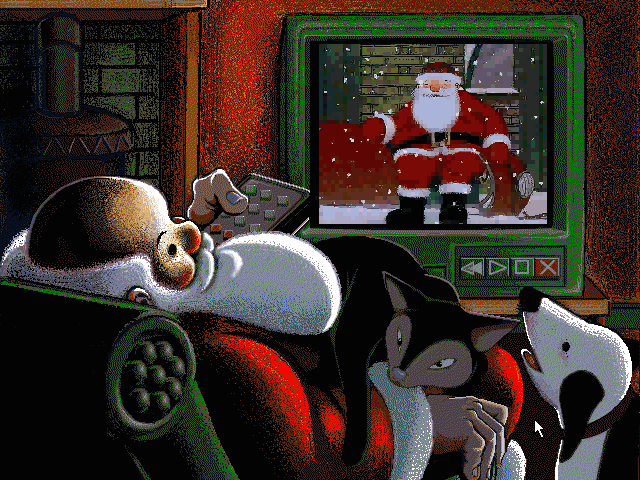
The disc does have one other primary feature: a full copy of the 1991 Father Christmas cartoon. It's a reasonably generous extra for 1995, when a movie on VHS could cost as much as a computer game, although even for the time the 12 frames per second video that fills barely 1/5 of the screen wouldn't have been considered the best viewing experience.
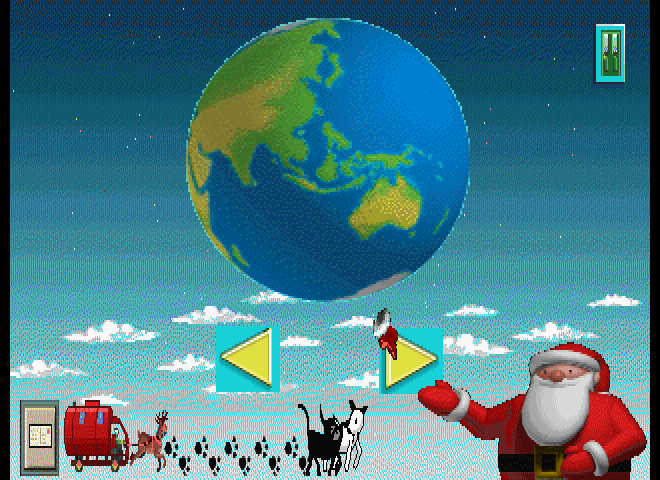
Father Christmas was developed in 1995 by Millennium Interactive, at the time a small British studio; they would eventually become more famous after being bought by Sony, for whom they developed games like MediEval (1998) and Killzone: Mercenary (2013). It was published by Japanese media company Gaga Communications, which was very active in CD-ROM game development in the mid-90s, and released simultaneously for Windows PCs and the Sega Saturn game console. The latter was an unusual choice for this kind of educational game, but Gaga seems to have been making a big push to try and expand their computer CD-ROM market into consoles[1]. The result isn't terribly successful; this is a very barebones port of an already pretty limited piece of educational software, with poorly-converted artwork that looks closer to a first-pass placeholder than something that was ready for release.
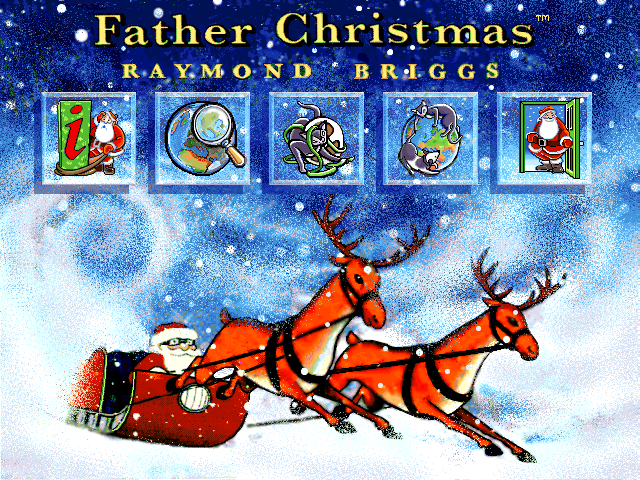
An open question with a game developed like this is what language it was developed in. Did the team work in their native language and let the publisher translate it for the target market? Did the publisher assign a writer to write the game natively in their target language? As it happens, Father Christmas has files left over on the disc that make this abundantly clear. The PC disc was mastered with a number of leftover development files on it, including most of the content necessary for a complete English version of the game. The credits list a single English name for the game's text, and more significantly an entire unused English script is present on the disc. Written in a colloquial British English, this is almost certainly the original script created by the game's developers before it was translated into Japanese. Beyond just the script itself, it contains text files which appear to be notes from the developers itemizing content they expected to be in the game along with the speaking script for Father Christmas's voice in English and Japanese.
Beyond just the script, it also includes a full set of English graphical assets for the title screen and text-based buttons. The only resources missing English versions are Father Christmas's voice acting and the Father Christmas cartoon, both of which are the sort of expensive resources that the development team would have been unlikely to be doing on their own. None of these English resources are present in the Sega Saturn version.
Another surprise on the disc is a set of assets for an unreleased Mac version. Millenium's other Christmas game, The Snowman, was released simultaneously for Mac and PC, and it seems they may have considered doing the same with Father Christmas. Not all of the assets are present, and there's no actual Mac executable, but it does contain a complete set of Mac-format text assets, a developer tool for converting PC-format text files to Mac, and a single Mac-format video.
This has been a fairly trivia-heavy post, but sometimes there simply isn't that much interesting to say about a game. Father Christmas isn't especially well-crafted, but it's a game with some surprising discoveries to it and sometimes that's enough.
1. Gaga Communications was a coproducer on the film, so they also had good reason to commission this game even if they only planned to release it in Japan. ↩